The short answer
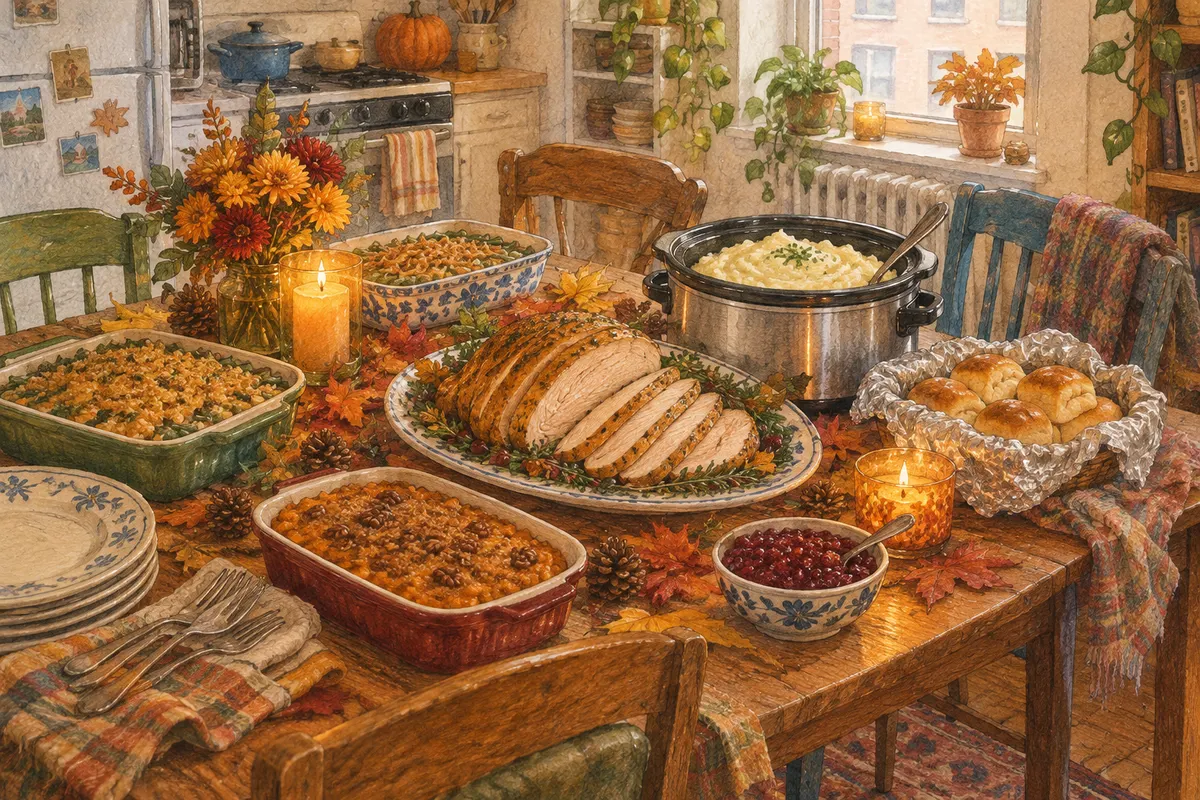
You cook the turkey, or a bone-in breast or spatchcocked bird that fits one oven shelf, plus one other dish. Everything else comes from guests who each claim one open slot on a shared list, including a vegetarian main and a line for allergies. Ask each guest to bring their dish in a known state (cold, reheated on the stove or in the microwave, or needing the oven), then run the oven in a fixed order: turkey out at least 30 minutes before you eat, casseroles and rolls in while it rests, then the oven at 200°F to hold. Tell people dinner is 30 minutes after they should arrive, so a friend who is 20 minutes late still makes dinner.
Who brings what: sign-up slots, and how each dish travels and reheats
| Slot | How it travels | What it needs from your kitchen | Where it waits |
|---|---|---|---|
| Turkey or bone-in breast (you) | Cooked at your place | The oven first, at 325°F or higher, until 165°F in the thigh, wing and breast | Rests uncovered 30 minutes, then carved and covered in the 200°F oven |
| Gravy (you, your second dish) | Base made at your place 2 to 3 days ahead | Stovetop, brought to a full boil with the drippings stirred in | An insulated carafe on the table |
| Mashed potatoes | Covered pot or foil pan, warm or chilled | Stovetop or microwave until steaming and 165°F, stirring in a splash of milk | A small slow cooker on warm, at 140°F or above |
| Stuffing | Assembled in its baking dish, or already baked | The oven, covered with foil, until 165°F in the center | The 200°F oven |
| A casserole that can be a vegetarian main (mac and cheese, baked pasta, stuffed squash) | In its baking dish | The oven, covered, until 165°F in the center | The 200°F oven |
| Vegetable sides | Container, roasted or steamed the day before | Microwave or toaster oven, so the main oven stays free | Covered on the counter for a few minutes |
| Rolls | Wrapped in foil | 350°F oven for about 5 minutes, last thing in | Foil on the table, in a towel-lined basket |
| Cranberry sauce | Jar, cold | Nothing, just take it out of the fridge an hour ahead | The counter |
| Salad | Greens in a bowl, dressing in a jar | Nothing, and dress it right before serving | The fridge until the last minute |
| Pies and desserts | Box or carrier; pumpkin and custard pies stay cold | Nothing, so they can ride in the fridge | The fridge until dessert |
Temperatures for turkey, reheating and holding are from the USDA Food Safety and Inspection Service. Oven holding, the slow cooker, gravy and resting times are from America's Test Kitchen, and the roll reheating is from King Arthur Baking.
Step-by-step
- 1
Decide what you cook, then count back from the date
America's Test Kitchen suggests the host make no more than two dishes. For you that is the turkey and the gravy. The USDA allows about 1 pound of turkey per person, but with eight sides on the table people take less turkey, so treat that as a ceiling. For eight friends, a bone-in turkey breast fits one oven rack, and the USDA's chart gives a 4 to 8 pound breast 1½ to 3¼ hours at 325°F, which is wide enough that the thermometer decides, not the clock. A spatchcocked small bird works too: America's Test Kitchen says flattening it cuts the cooking to a couple of hours on one shelf. A frozen bird needs time in the fridge first. For a Saturday, November 21 dinner, a turkey under 12 pounds goes in the fridge by Wednesday, November 18 (the USDA allows 1 to 3 days), and 12 to 16 pounds goes in by Tuesday, November 17 (3 to 4 days).
- 2
Send one message with open slots, not categories
Asking each friend "what do you want to bring?" one at a time is how you end up with three mac and cheeses. Write the whole list once in a shared note or spreadsheet, with one line per slot (the table above is a starting point), and ask everyone to type their name next to one line. Each slot exists once, so duplicates can't happen unless you add a second one on purpose. Put a vegetarian main in the list as a real slot, which is also where a mac and cheese belongs. Guests who don't cook have easy ways in: America's Test Kitchen says instant mashed potatoes, boxed stuffing and frozen dinner rolls are fine, and drinks, ice and paper goods are a slot too.
- 3
Ask about allergies in the same message
Put one line in the first message: "Tell me anything you can't eat." The USDA lists the nine leading food allergens as milk, eggs, fish, shellfish, tree nuts, peanuts, wheat, soybeans and sesame, and listing them in the invite helps guests remember things like the wheat in a gravy thickener or the nuts in a pie crust. Ask guests to add the main ingredients next to their name, put a small card by each dish when it lands on the table, and give every dish its own serving spoon so a spoon doesn't carry crumbs and sauce from one dish to the next.
- 4
Give every dish a lane before it arrives
Your kitchen has a fixed number of heat sources: one oven, a few burners, a microwave and maybe a toaster oven or a slow cooker a guest can bring along. America's Test Kitchen's small-kitchen advice is to use every one of them, such as microwaving a squash or beet side and reheating roasted vegetables in a toaster oven. Ask each guest to pick a lane when they sign up: cold or room temperature, stove or microwave, or oven. Plan for about two oven dishes plus the rolls, since that is roughly what two racks hold in the 30 minutes while the turkey rests. A guest whose dish needs the oven for an hour should bring it already warm from their own oven, or choose a slot from the first two lanes.
- 5
Run the oven in a fixed order
The turkey goes in first and comes out at least 30 minutes before you eat. America's Test Kitchen says to rest it uncovered, because tenting makes the skin soggy (the USDA suggests at least 20 minutes). While it rests, the oven is free: turn it to 350°F and put the casseroles and stuffing in covered, then add the rolls wrapped in foil for the last 5 minutes, which is King Arthur Baking's instruction for soft rolls. After that, drop the oven to 200°F, which America's Test Kitchen uses to hold cooked dishes and which sits well above the USDA's 140°F line for hot food. Mashed potatoes get reheated on the stove or in the microwave to 165°F and then go into a preheated slow cooker on warm. The USDA does not recommend reheating food in a slow cooker, only holding it there at 140°F or above. Gravy gets a full boil on the stove, which is the USDA's rule for reheated sauces, and then goes into an insulated carafe.
- 6
Set the dinner time half an hour after the arrival time
Write "come at 3:30, we eat at 4:00" on the invite and serve cheese, olives or whatever the appetizer slot brings in the gap. Start eating at 4:00 even if two people are missing, and set a plate aside for each of them under foil in the 200°F oven. Carve the turkey and keep the slices covered with a splash of broth, which is the USDA's tip for keeping reheated turkey moist, in the oven until the line starts. A late guest's dish goes through the same lane as everyone else's. If it arrives hot, check it with a thermometer, and anything under 140°F gets heated to 165°F before it goes on the table.
- 7
Plan seats, plates and leftovers for an apartment
Buffet style is the usual answer when the table seats six and eleven people are coming. America's Test Kitchen suggests spreading dishes across counters, a TV stand or a bookshelf, and serving from sheet pans, cutting boards and mixing bowls instead of matching platters. Sturdy 8-inch paper plates, disposable forks and butcher paper as a tablecloth mean less washing up. Ask a couple of guests to bring a folding chair or floor cushion, a cooler for drinks, and a container for leftovers. Leftover turkey and sides need to be cooled quickly in shallow containers, and guests with their own containers take half of it home for you.
Common mistakes to avoid
- ✕
Buying a bigger turkey than your oven can handle
A whole 18-pound bird takes 4¼ to 4½ hours at 325°F by the USDA's chart and holds the oven most of the afternoon, with the rest period still to come. Eight guests do not need it, and a breast or a smaller flattened bird leaves the oven free much sooner.
- ✕
Assuming the sides are vegetarian
Stuffing is often made with chicken broth and gravy with turkey drippings, and a vegetarian guest sees a table where the only thing they can eat is the salad. Ask the stuffing slot for a version made with vegetable stock.
- ✕
Tenting the turkey with foil to wait for latecomers
Covering a resting bird traps steam and softens the skin, which is the part friends are already hovering over. Rest it uncovered, carve it on time, and hold the carved slices covered with a little broth in the 200°F oven.
- ✕
Leaving the buffet out all evening
The USDA says to throw away perishable food that has sat out for more than 2 hours (1 hour above 90°F). A Friendsgiving that runs from 4:00 to 9:00 goes well past that. Put the leftovers away when people go back for second plates, and for cold dishes use small trays you replace, or nest the bowl in ice.
Why Culinary Card works for this
Friendsgiving ends with ten great recipes scattered across ten phones. Culinary Card can pull them into one book from links, pasted text or a photo of a card, and you can share the book with the group by link or QR code so everyone can cook the dish they liked.
Frequently asked questions
Which weekend should I pick for Friendsgiving?
The weekend before Thanksgiving, which is November 14 or 21 this year. The 14th is easier on guests who leave town the week of Thanksgiving, and the 21st is closer to the holiday, so the turkey feels more like the real thing.
Can I roast the turkey the day before?
Yes. The USDA says cooked turkey can be eaten cold or reheated, so it is an option when the oven is the problem. Cut it into smaller pieces, slicing the breast, and refrigerate it within 2 hours in shallow containers. Reheat it in the oven at 325°F or higher until a thermometer reads 165°F, with a splash of broth or water and a cover so it stays moist. You give up crisp skin, so this works best if the skin is not what your friends fight over.
How much should each guest's dish serve?
A normal family-size dish, such as a 9×13 pan or a large bowl, per guest or per couple. With ten dishes on the table, everyone takes a few spoonfuls of each.
Is a hot dish safe after a car ride?
It can be. The USDA's rule is that hot food stays at 140°F or above, and anything that sits at room temperature for more than 2 hours after leaving a warm appliance should be thrown away. A dish wrapped in a towel for a short drive often stays warm, but a thermometer in the middle on arrival is the only way to know. Cold dishes should travel at 40°F or below, in a cooler.
How long do Friendsgiving leftovers last?
The USDA gives leftovers 3 to 4 days in the fridge, or 3 to 4 months in the freezer. Turkey, stuffing and gravy are on the same 3 to 4 day clock. The USDA's turkey page says frozen leftovers hold their quality for 2 to 6 months, so go with the shorter 3 to 4 months if you want the safer figure. Reheat everything to 165°F and bring gravy to a rolling boil.
What can a guest bring who doesn't cook?
Ice, drinks and a cooler to keep them in, paper plates and napkins, a store-bought pie, or one of the shortcut sides America's Test Kitchen approves: instant mashed potatoes, boxed stuffing or a pan of frozen dinner rolls. All three fit the lanes in the table.
Sources
- Let's talk turkey: a consumer guide to safely roasting a turkey, USDA Food Safety and Inspection Service
- Leftovers and food safety, USDA Food Safety and Inspection Service
- Slow cookers and food safety, USDA Food Safety and Inspection Service
- Food allergies: the "Big 9", USDA Food Safety and Inspection Service
- 7 tips for hosting the best Friendsgiving ever, America's Test Kitchen
- How to cook a Thanksgiving meal in a small kitchen, America's Test Kitchen
- The ultimate Thanksgiving make-ahead timeline, America's Test Kitchen
- Thanksgiving game plan and hotline, America's Test Kitchen
- Soft golden rolls and buns, King Arthur Baking