The short answer
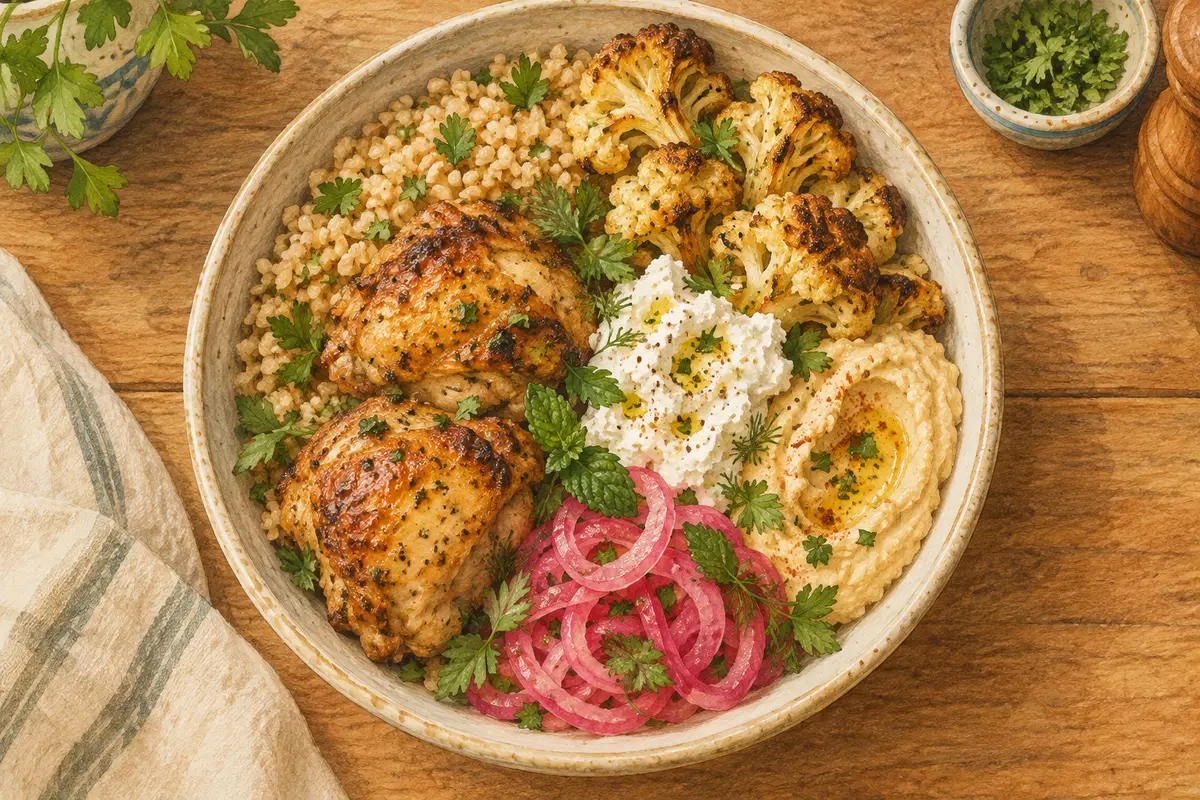
Build every bowl from six parts: a warm grain, a protein, a roasted or pickled vegetable, a spread, a bright dressing and something crunchy. On Sunday, spend about 90 minutes making one pot of rice, six marinated chicken thighs, a tray of roasted cauliflower, pickled onions, a hummus or feta spread and one dressing, which covers four lunches. Keep the warm parts, the spreads, the dressing and the greens in separate containers, reheat the chicken and rice to 165°F, and put each bowl together at lunchtime. USDA gives cooked leftovers 3 to 4 days in the fridge, so freeze any extra portions on Sunday.
The six parts, for four lunches
| Part | Fridge life | Reheat or hold | Approx. protein per bowl |
|---|---|---|---|
| Warm grain: 1 cup dry brown rice, about ¾ cup cooked (150 g) a bowl | 3 to 4 days | Cover, add a splash of water, reheat to 165°F | 4 g |
| Protein: chicken thigh meat, about 4 oz (113 g) cooked a bowl | 3 to 4 days | Cover and reheat to 165°F | 28 g |
| Protein swap: cooked lentils, 150 g a bowl | 3 to 4 days | Cover and reheat to 165°F | 14 g |
| Roasted vegetable: cauliflower wedges, 2 a bowl | 3 to 4 days | Reheat with the rice and chicken | Left out (small) |
| Pickled vegetable: red onion in red wine vinegar | No tested time found, so use within 4 days | Drain and keep cold | 0 g |
| Spread: hummus, about ¼ cup (60 g) a bowl | 3 to 4 days (homemade hummus is listed at up to 1 week by Serious Eats) | Add cold, after reheating | 5 g |
| Spread: whipped feta dip, about 55 g of feta a bowl | 3 to 4 days | Add cold, after reheating | 8 g |
| Bright dressing: lemon-herb, about 2 tablespoons a bowl | Use within 4 days | Keep in a jar, add last | Left out (small) |
| Crunch and greens: cucumber, greens, pita chips or nuts | Cut the cucumber the day you eat it | Keep dry and separate | Left out (small) |
Fridge times for cooked food follow USDA FSIS leftovers guidance (3 to 4 days at 40°F or below). Protein is arithmetic from USDA FoodData Central (SR Legacy) values per 100 g: roasted chicken thigh meat 24.8 g (FDC 172388), cooked brown rice 2.74 g (169704), boiled lentils 9.02 g (172421), commercial hummus 7.78 g (174289) and feta 14.2 g (173420). The portion weights are round numbers chosen for this guide, so treat every figure as approximate. A bowl of chicken, rice, hummus and feta comes to roughly 45 g before vegetables, dressing and crunch.
Step-by-step
- 1
Run Sunday in this order
Marinate the chicken first (30 minutes on the counter, or up to 24 hours in the fridge, per Serious Eats), then start the rice, since brown rice takes the longest on the stove and the package gives its time. While the chicken and cauliflower roast, blend the spread and dressing and soak the sliced onion in vinegar. Quantities for four lunches: 1 cup dry brown rice, 6 bone-in skin-on chicken thighs (about 2¼ pounds), 1 head of cauliflower, 1 small red onion, about 1 cup of hummus, 8 ounces of feta, 1 cucumber, and four handfuls of greens. With the oven and the burner busy at once, this lands near 90 minutes.
- 2
Marinate the thighs with a ratio you can scale
For six thighs, whisk 6 tablespoons olive oil, 2 tablespoons lemon juice, 2 teaspoons Diamond Crystal kosher salt (1 teaspoon if you only have table salt), 1 or 2 minced garlic cloves and 2 tablespoons of a simple spice mix, such as equal parts ground cumin and coriander with a little smoked paprika and black pepper. That ratio comes from Serious Eats' sheet-pan shawarma, which uses a longer spice list. Roast skin side up at 475°F on a rimmed pan, leaving the edges of the pan empty. Their version takes about 35 minutes. Check the thickest part with a thermometer: USDA's minimum for poultry is 165°F, and Serious Eats pulls thighs at 175 to 185°F for a more tender texture, so either number is safe.
- 3
Roast the cauliflower and pickle the onion
Cut the head through the core into 8 wedges, toss with 3 tablespoons of olive oil, salt and pepper, and roast, flipping once, until deeply browned on both sides. Serious Eats uses 500°F for about 20 minutes. Since the chicken is already at 475°F, run the cauliflower on a second pan in the same oven and start checking at 20 minutes. For the pickle, slice a small red onion thin, add a pinch of salt, pour in enough red wine vinegar to cover, stir once or twice, and leave it 15 minutes to an hour. Drain it into a jar for the fridge.
- 4
Blend one spread, one dressing, and buy the other
Store-bought hummus is fine. If you make it, two Serious Eats techniques matter most: purée the garlic in the lemon juice first, which tames its harshness, and blend the chickpeas while they are hot with some of their cooking liquid. Their canned-chickpea shortcut is to rinse the can and simmer the chickpeas about an hour with aromatics. For a feta spread, blend 8 ounces of feta with 3 tablespoons olive oil, 1 seeded jalapeño and a tablespoon of water until smooth. For a dressing like skhug, a spicy Yemeni herb sauce, use 1 part lemon juice to 2 parts olive oil: 2 tablespoons lemon juice, ¼ cup oil, about 1 cup packed parsley and cilantro, 1 small jalapeño, 1 small garlic clove, ½ teaspoon cumin and ¼ teaspoon salt. Blend it loose and spoonable. That ratio is a starting point from this guide, not a tested recipe, so taste it. For a creamier swap, Serious Eats' yogurt sauce keeps up to 4 days: ½ cup strained yogurt, ¼ cup tahini, 3 tablespoons lemon juice, 2 tablespoons oil, 1 tablespoon honey, 1 garlic clove and water to thin.
- 5
Cool it fast and pack it in four groups
USDA says to refrigerate cooked food within 2 hours and to split it into shallow containers so it cools quickly. Hot food can go straight into the fridge. Pack four groups: (1) rice, chicken and cauliflower together, (2) spreads, (3) the dressing in its own jar, and (4) greens, cucumber, pickled onion and pita chips or nuts, kept dry. Cut the cucumber on the day you eat it. That keeps the greens and pita chips dry through day 4.
- 6
Reheat the warm parts, then add the cold ones
Put the rice, chicken and cauliflower in a covered dish with a splash of water. USDA says to cover leftovers, rotate them in the microwave, check the temperature in several places and reach 165°F. Then add greens, spoons of hummus and feta, pickled onion and cucumber, and dress it last with a squeeze of lemon. Taste after reheating and add lemon or salt if it needs it. For any extra lunches, freeze portions of rice and chicken on Sunday. USDA lists 3 to 4 months in the freezer, and thawing in the fridge keeps them safe.
Common mistakes to avoid
- ✕
Pulling the thighs by color or by the clock
Thigh size, pan crowding and oven hot spots all change the timing, and the marinade can brown the outside well before the center is done. An instant-read thermometer in the thickest part shows when the chicken reaches 165°F. The higher 175 to 185°F range Serious Eats uses is for texture.
- ✕
Cutting the cauliflower small
Small florets cook through before they brown. Serious Eats cuts a head into fat wedges so the outside caramelizes while the inside stays tender, and on its shawarma pan it leaves the pan edges empty and adds the softer vegetables late. A second pan for the cauliflower costs one more thing to wash.
- ✕
Swapping salt by the spoon
Serious Eats develops its recipes with Diamond Crystal kosher salt and says to use half as much table salt by volume. Measuring table salt with the kosher salt spoon puts roughly twice as much salt in the marinade, and that chicken then sits in the fridge for four days.
Why Culinary Card works for this
Culinary Card can hold your own version of this formula. Under Add recipe, use the Text or link tab to paste your rough Sunday notes or the link to this page, and keep the ratios and oven times on one printable card.
Frequently asked questions
Can I use chicken breast instead of thighs?
Yes. The safety rule is the same: USDA lists 165°F for all poultry. Breasts have less fat and dry out faster, so slice them thin before reheating and check the temperature early. The protein figure also differs from thighs, so look up breast in FoodData Central if you track it.
How do I make these bowls vegetarian?
Swap the chicken for cooked lentils or canned chickpeas. By the USDA values, 150 g of cooked lentils has about 14 g of protein, and 60 g of drained canned chickpeas has about 4 g. With rice, hummus and feta, a lentil bowl comes to about 31 g. Lentils and chickpeas follow the same 3 to 4 day fridge window.
Is it cheaper than buying lunch?
Probably, but this guide does not quote a menu price, because prices vary by location and change. Keep the grocery receipt for your first batch and divide it by four. The chicken, feta and tahini or hummus are the costly items, and the spices, oil and vinegar carry over to the next week.
Can I freeze the whole bowl?
Freeze the rice and chicken, not the greens, cucumber or pickled onion. USDA says leftovers keep 3 to 4 months frozen and that you can reheat frozen leftovers without thawing, though it takes longer. Hummus and the dips are better made fresh or bought each week, since no tested freezer time for them turned up in the sources used here.
Sources
- Leftovers and Food Safety, USDA Food Safety and Inspection Service
- Safe Minimum Internal Temperature Chart, USDA Food Safety and Inspection Service
- Chicken Shawarma Sheet-Pan Dinner, Serious Eats
- The Food Lab's Science of Great Hummus, Serious Eats
- Roasted Cauliflower With Pine Nut, Raisin, and Caper Vinaigrette, Serious Eats
- Quick-Pickled Onions, Serious Eats
- FoodData Central, SR Legacy, USDA Agricultural Research Service